Key takeaways:
- IPv4 and IPv6 are two Internet Protocol versions that assign IP addresses so devices can communicate across the internet.
- IPv6 was created to solve IPv4’s limited address space by introducing 128-bit addresses and vastly more unique IPs.
- Today’s internet runs on both IPv4 and IPv6, with performance differences depending more on network infrastructure than the protocols themselves.
You may be looking into IPv4 vs IPv6 proxies after noticing a strange price gap between them. In other cases, you may simply be trying to understand whether IPv4 or IPv6 proxies will work better for your specific use case.
This article explains how IPv4 and IPv6 differ at the network level. You will learn how each protocol handles IP addresses, why IPv6 introduced a larger address space, and how that change affects the available addresses in proxy networks.
The foundation: What is an IP address?
Before we talk about proxies, it helps to understand what an IP is. Think of it as your digital street address on the internet. When your laptop or phone sends a request online, the Internet Protocol packet includes:
- The destination address of the website
- The return address, which is your IP
For example, if you send a request to Instagram, the server may see something like:
Request from: 197.248.102.55
That IP address tells the server where to send the response. If you want a deeper explanation of how IP addresses work and how they can be traced, see our guide on how to track an IP address.
What is a proxy server?
Now, suppose you do not want to send the request directly to Instagram because:
- You are running multiple Instagram accounts on the same device
- You want an Instagram account linked to a specific location
- You want the session to stay private
In that case, you would use something called a proxy server. It sits between your device and the destination server. When configured, your request is sent to the proxy first, then to Instagram.
Instagram sees the proxy server’s IP and sends the response to it. The proxy server then forwards the response back to your device. Depending on the type of proxy server used, the platform may or may not detect that a proxy is part of the request chain.
Residential proxies, for example, are often harder for websites to identify because they use IP addresses from real devices.
What is IPv4?
An IP address is your digital street address, while a proxy server is a tool that lets you hide that IP and use another one.
For all these devices to communicate online, they rely on something called the Internet Protocol. Loosely speaking, it is a set of rules that allow platforms like Instagram to read IPs, determine where a request came from, and send a response back to that location.
This brings us to IPv4, which stands for Internet Protocol version 4. It is the original internet addressing system that the internet was built on, and the format most people recognize.
You may have seen an IPv4 address before. It looks like this:
X.X.X.X
Each X represents a number between 0 and 255. Examples include:
- 8.8.8.8
- 172.217.15.110
Why IPv4’s limited address space became a problem for the internet
IPv4 was born in the late 1970s and standardized in the early ‘80s, back when the internet was basically a tiny research network linking up universities, government labs, and a handful of other organizations.
Because IPv4 uses four numbers separated by dots, the protocol provides about 4.3 billion possible IP addresses. At the time, this number seemed more than enough, but it turned out to be woefully inadequate as the internet expanded far beyond what early engineers had in mind.
Today, a large number of devices rely on IP addresses to get online and communicate. Here are a few common examples:
- Smartphones
- Personal computers
- Smart TVs
- Game consoles
- Servers
Early allocation also created problems. Big chunks of IPv4 addresses were handed out to universities, corporations, and government agencies without any real anticipation of how quickly demand for addresses would grow.
As a result, some organizations ended up with way more addresses than they needed. By the early 2000s, experts were starting to notice that the pool of available addresses was shrinking fast.
That's when engineers invented Network Address Translation (NAT). NAT lets many devices share a single public IP. For example, your home router may have one address for the entire household to share.
It's not a perfect solution, though.
Even with NAT in place, the basic problem remains the same - there just aren't enough addresses to go around. Add that to the fact that some applications need a direct connection to function correctly, and it's easy to see why IPv4 addresses have become increasingly expensive these days.
What is IPv6?
IPv6 was built to address the scarcity problem of IPv4. It performs the same basic job: assigning IPs so devices on the internet can communicate.
This newer protocol solves the scarcity problem by introducing a much larger address space. Because of this expansion, IPv6 uses hexadecimal numbers, which produce much longer IP addresses than IPv4.
An IPv6 address may look like this:
2001:0db8:85a3:0000:0000:8a2e:0370:7334
They are often shortened to make them easier to read. The same address listed above may also appear like this:
2001:db8:85a3::8a2e:370:7334
So while IPv4 uses 32-bit addresses that produce about 4.3 billion combinations, IPv6 uses 128-bit addresses. That creates around 340 undecillion possible addresses.
That number is extremely large and difficult to picture. Written out fully, it looks like this:
340,000,000,000,000,000,000,000,000,000,000,000,000
In practical terms, the internet is unlikely to run out ofIPv6 addresses.
Key advantages of IPv6 over IPv4
- Massively expanded address space
IPv4's 32-bit addresses can manage about 4.3 billion addresses. IPv6's 128-bit addresses, on the other hand, create an enormous 340 undecillion possible addresses. As a result, the internet is unlikely to run out of IPv6 addresses anytime soon.
- Vastly more unique IPs
The much bigger address pool in IPv6 means you can assign unique IPs to a whole lot more devices. With IPv4, devices often share a single public IP address through NAT. IPv6 reduces that necessity and lets devices have their own addresses.
- Reducing dependence on NAT
IPv4 networks rely heavily on NAT to allow many devices to use a single public address. This reliance on NAT extended the life of IPv4 but complicated some forms of communication, like peer-to-peer, online gaming, and Voice over Internet Protocol (VoIP). IPv6 reduces this dependency because devices can get their own public IP address.
- Routing becomes more efficient
IPv6 was built with a hierarchical addressing structure that makes traffic move much more smoothly across the internet. This structure lets routers process network paths much more quickly. This leads to smaller routing tables and better routing across the internet.
- Autoconfiguration that works
IPv6 supports automatic address assignment through auto configuration mechanisms such as Stateless Address Autoconfiguration (SLAAC). Devices can automatically obtain IP addresses when they connect to a network.
IPv4 vs IPv6: Key differences
32-bit
128-bit
Written in a numeric format consisting of four numbers separated by periods
Written using a colon-separated hexadecimal notation
About 4.3 billion possible addresses
About 340 undecillion possible addresses
Commonly relies on NAT because of the limited address space
Usually does not require NAT because the address space allows many unique IPs
Internet Protocol Security (IPsec) support exists, but is optional and not always implemented
IPsec support is built into the protocol design
Often uses DHCP servers to assign IPs
Supports SLAAC for automatic address assignment
Uses broadcast traffic to communicate with multiple devices on a network
Eliminates broadcast and relies on multicast and anycast instead
The header structure is more complex and includes optional fields
Header structure is simplified for more efficient routing
Uses A records in DNS to map domain names to IPv4 addresses
Uses AAAA records in DNS to map domain names to IPv6 addresses
IPv4 vs IPv6: Performance, security, and scalability
Now that you know the difference between IPv4 and IPv6, let’s look at how they compare where it really counts: performance, security, and scalability across the modern internet infrastructure.
Performance differences
You'd be surprised to find out that IPv6 doesn't always outperform IPv4. Depending on your network, IPv6 can be faster, just as efficient, or sometimes even slower. Understanding how different IPs perform really comes down to seeing how each handles routing.
Routing efficiency
- How it works in IPv4
IPv4 routing works by having routers forward packets using destination IP addresses stored in routing tables. The limited IPv4 address space led to fragmented allocations and widespread NAT, which adds complexity to network design.
- How it works in IPv6
IPv6 routing also forwards packets based on destination IP addresses. But the much larger address space allows more structured allocations through hierarchical addressing. This supports route aggregation, helps maintain cleaner routing tables, and makes it easier to organize networks into smaller segments. See our guide on what a subnet ID is and how it works to see how these segments are identified.
The main gain in routing efficiency between IPv4 and IPv6 is really about making networks easier to manage and scale. This is great for the infrastructure, but as an everyday internet user, you might not even notice a difference.
IPv6 also replaces broadcast traffic with multicast communication. Instead of sending packets to every device on a network, multicast delivers data only to systems that request it. This reduces unnecessary traffic and can improve network efficiency.
Header simplification
- How it works in IPv4
IPv4 headers have many optional fields and a variable length. Routers have to interpret these fields and recalculate a checksum as packets move across networks, which adds extra processing during packet forwarding.
- How it works in IPv6
IPv6 has a fixed-length base header. Optional information is moved into extension headers, and the protocol removes the header checksum, reducing the processing work for routers.
The simplified header structure can also reduce processing overhead inside routers. Combined with more efficient routing, IPv6 networks may experience lower delays in some environments compared to IPv4 networks.
Real-world performance expectations
So will IPv6 actually make your network faster? In practice, the answer varies. Performance differences often depend more on infrastructure than on the IP version itself.
Security comparison
You may have heard about IPsec and how it supposedly makes IPv6 more secure. But does that actually mean IPv6 is safer than IPv4? To answer that, we need to look at how security works in each IP version.
- How security works in IPv4
IPv4 was designed during an earlier stage of the internet before many modern threats existed. Because of that, security is usually added through external tools such as firewalls and proxies rather than built directly into the protocol.
- How security works in IPv6
IPv6 includes built-in support for IPsec. This suite of protocols helps secure communications by verifying identity and protecting data as packets move between devices.
So, is IPv6 really more secure?
Not necessarily. While IPv6 supports IPsec at the protocol level, real security still depends on network configuration, software, and operational practices. In many environments, well-managed IPv4 and IPv6 networks can provide comparable security.
Scalability and future readiness
The fact is, the differences in how IPv4 and IPv6 perform aren't that huge, and security-wise, it's not a massive leap forward either. Where IPv6 really starts to show its worth is with scalability. Its vastly larger address space is just what the internet needs today.
- Mobile devices
Smartphones and tablets live and die by their ability to roam through different networks, and IPv6 makes this much easier thanks to its massive address space. Larger address pools also make it easier for networks and proxy systems to assign and rotate IP addresses when devices reconnect or change networks.
- Cloud infrastructure
Cloud providers these days are running tens of thousands of virtual machines and services - each of which needs a unique IP address. IPv6 makes this easier and way less of a headache for system designers, whereas IPv4's limited address space is starting to show its age.
IPv6 will continue to become essential over time as the internet keeps expanding. Its larger address space supports massive numbers of connected systems while maintaining hierarchical addressing that helps facilitate efficient routing across global networks.
IPv4 to IPv6 transition and compatibility
Today’s internet runs on both IPv4 and IPv6. Millions of devices still depend on IPv4, so global adoption of the newer IP version has progressed slowly. Compatibility becomes important in this mixed environment.
Some systems recognize IPv4 only, while others support IPv6 or both. Because the two protocols are not backward compatible, networks rely on transition technologies to keep communication working.
Common transition methods
Dual-stack
Dual-stack means a system runs both IPv4 and IPv6 at the same time. A server or device receives two IP addresses, one for each IP version, allowing it to communicate across both networks. When a connection happens, the system simply uses whichever IP version the destination device supports.
Tunneling
Tunneling enables IPv6 traffic to move across networks that still rely on IPv4 infrastructure. An IPv6 packet is placed inside an IPv4 packet, allowing the IPv4 network to transport the data even though the original communication uses IPv6.
The IPv4 infrastructure carries the packet across the network. When it reaches the tunnel endpoint, the IPv4 wrapper is removed, and the original IPv6 packet continues across to the target.
Translation
Translation is used when an IPv6 device must communicate with a system that only supports IPv4. These systems convert traffic between the two IP versions so communication can continue even when devices use different IP formats.
One common example is NAT64, a form of Network Address Translation that converts IPv6 traffic into IPv4 requests so packets can reach servers that only recognize IPv4 addresses.
Why full IPv6 adoption is slow
As of the time of this publication, IPv6 adoption remains relatively low. This is despite the Internet Assigned Numbers Authority (IANA) running out of free IPv4 addresses in 2011 and Europe’s Regional Internet Registry exhausting its remaining IPv4 pool in 2020.
Global adoption data reflects this slow transition. In early 2025, IPv6 usage was just below 50% worldwide. Some regions have moved faster than others, with countries such as France, Germany, and India showing higher IPv6 adoption rates than the United States.
There are several solid reasons for this slow transition:
- IPv4 still gets the job done
Despite the fact that IPv4's address space is limited, the old protocol still manages to work just fine across much of the internet. NAT lets thousands of devices share a single public IP address, taking the pressure off switching to IPv6.
- The internet still supports both protocols
Millions of systems were originally built with IPv4 in mind, and the thing is, moving towards IPv4 and IPv6 compatibility can be expensive and time-consuming. You've got to upgrade hardware, update software, and get the networks all sorted out across the existing infrastructure.
Looking ahead, more organizations and countries are transitioning toward IPv6 as the limited IPv4 address space becomes harder to manage. Over time, this shift will continue to expand the role of IPv6 across global networks.
Conclusion
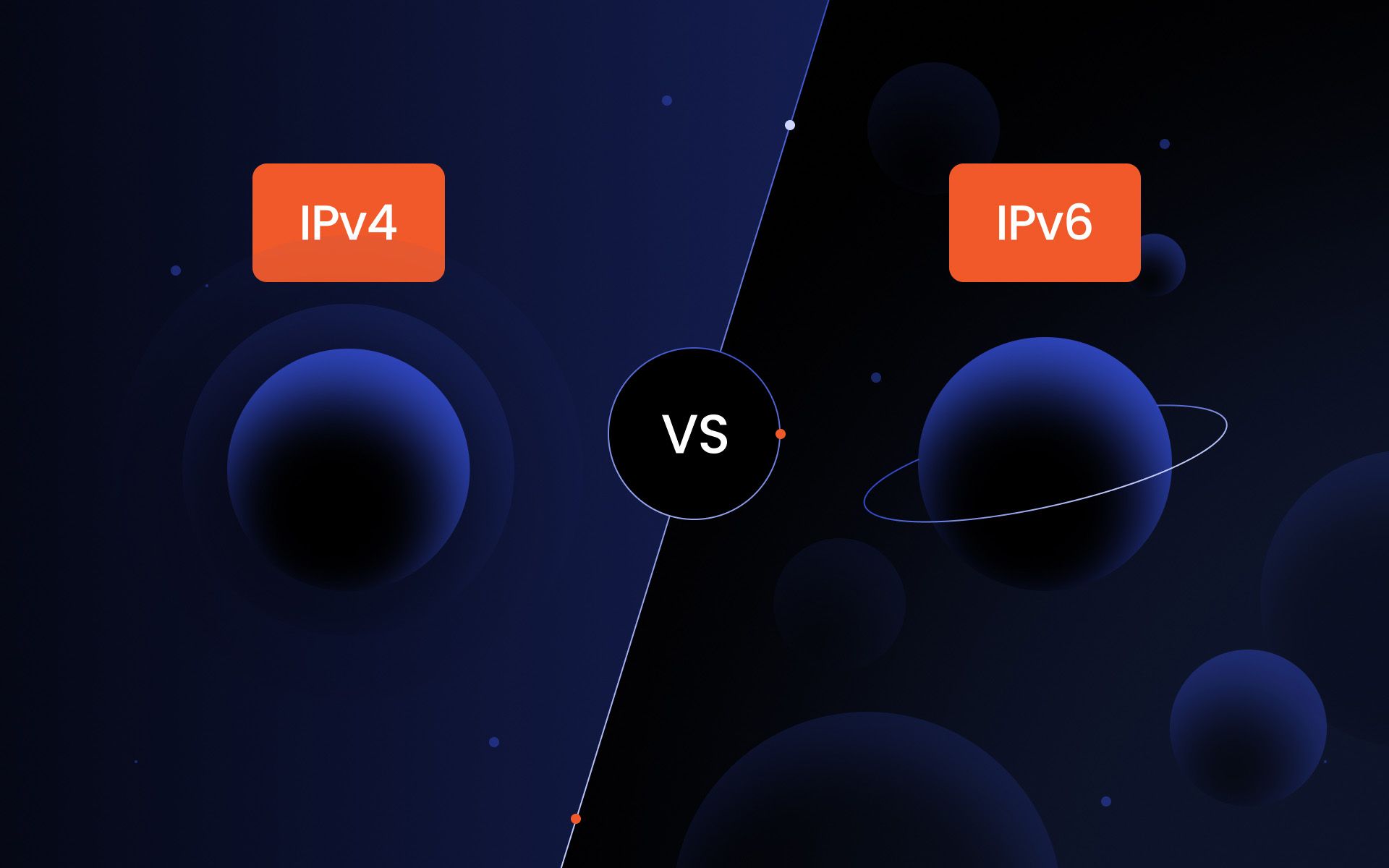
The key difference in the IPv4 vs IPv6 discussion lies in IP address availability. IPv4 operates within a limited address space, while IPv6 provides a much larger address space, allowing networks to assign far more unique IP addresses.
For practical decisions, IPv4 still makes sense where compatibility with existing systems matters. IPv6 is the better choice when scale is important, since its larger address space provides more available addresses as infrastructure grows. Want to dive deeper into networking, proxies, and scraping? Join our Discord community and chat with other builders.
What is the main difference between IPv4 and IPv6?
The main difference between IPv4 and IPv6 is their address space. IPv4 uses 32-bit addresses with about 4.3 billion combinations, while IPv6 uses 128-bit addresses, creating vastly more unique IPs.
Is IPv6 faster than IPv4?
IPv6 is not automatically faster than IPv4. In many networks, performance is similar. Actual speed usually depends on Internet Service Provider (ISP) configuration, routing paths, server infrastructure, and how well each protocol is supported.
Is IPv6 compatible with IPv4?
IPv4 and IPv6 are not directly compatible because they use different packet structures and address formats. Networks rely on transition methods like dual-stack, tunneling, or protocol translation to enable communication between the two systems.
Why isn’t IPv6 widely adopted yet?
IPv6 adoption is gradual because existing infrastructure still runs on IPv4. Upgrading hardware, software, and network systems requires time and cost, while technologies like NAT allow IPv4 networks to continue operating.
Should I enable IPv6 on my website or network?
Enabling IPv6 is generally recommended when your hosting provider and infrastructure support it. Running both IPv4 and IPv6 improves compatibility, ensures access for more users, and prepares your network for future growth.