Key takeaways:
- Data collection services automate web scraping, API access, and dataset delivery, helping businesses access real-time, accurate data at scale.
- Choosing the right data collection service improves decision-making, operational efficiency, and competitive intelligence across industries.
- Features like scraper APIs, global proxy networks, and automated web unblockers are essential for reliable large-scale data collection.
- Pricing, scalability, compliance support, and ease of integration are key factors when selecting a data collection provider.
In a world where waiting for valuable insights or working with incorrect, incomplete data can put you behind, using a data collection service is a no-brainer. Whether you’re analyzing your competitors, training AI models, or tracking real-time consumer trends, data collection services help you get the necessary data, right now.
But how do you choose the best data collection service for your business?
We’re here to help by reviewing the best options on the market and breaking down the key factors and industry use cases to consider before making a decision.
What are data collection services?
Data collection services are systems or platforms that automatically gather massive amounts of data from multiple sources. Instead of copying and pasting data from websites into spreadsheets, which can take hours and even days, they automate the extraction and data parsing of information through APIs, from ready-to-use datasets, or from websites.
These services specialize in data-related operations and have a deep understanding of data collection methodologies, data processing techniques, and compliance requirements. This expertise helps businesses enhance operational efficiency by using data analysis to pinpoint bottlenecks and inefficiencies in workflows.
With automated web scraping techniques paired with the right tools and proxies, data collection companies ensure continuous access to accurate, up-to-date information. At the same time, they reduce operational costs and boost efficiency, speeding up the entire data collection process.
Data collection services can gather information from various sources, including:
- Web data: publicly available information from websites such as product listings, pricing pages, reviews, and news sites
- APIs: structured data accessed directly from official application programming interfaces, offering higher reliability and consistency
- Social media: public posts, engagement metrics, and trend data from social platforms like Instagram, TikTok, or Twitter, now X, for sentiment analysis and market research
- E-commerce platforms & marketplaces: product catalogs, pricing, availability, and seller data from online marketplaces. If Amazon is your primary marketplace target, our guide on Amazon web scraping walks through the tools and techniques that work best against its defenses.
This enables improved decision-making through access to real-time, accurate data, helping you identify trends and patterns. As more companies rely on AI and big data for strategic advantages, the demand for data collection services continues to grow.
Top 5 data collection services in 2026
Actionable insights come from turning raw data into meaningful patterns that support better business decisions. This is where choosing the right data collection service becomes especially important.
Let’s cover the best data collection companies currently available on the market for web scraping, AI-driven data gathering, and scalable APIs. Once you learn what each of them offers, we’ll quickly compare them to help you choose the best option for your needs and budget.
Note: pricing, features, and ratings are accurate at the time of writing and may change.
1. Bright Data
Bright Data is a well-known name in the data collection industry. This giant offers everything you need for efficient data extraction, including:
- Multiple web scraping APIs: designed for structured data collection from almost any public website while handling proxies and CAPTCHA bypass automatically
- Ready-made datasets: pre-collected from over 120 popular e-commerce, social media, real estate, and other domains, coming with standardized schemes and formats such as CSV and JSON
- Custom, high-quality datasets: tailored to individual needs and optimized for AI model training
- A global proxy network: access to 150M+ residential, mobile, datacenter, and mobile IPs across the world with precise geo-targeting options
- A web unlocker: an automated unblocking tool that manages CAPTCHA solving, anti-bot defenses, and proxy rotation during web scraping
With so many web scraping tools and high-quality datasets for AI, Bright Data is a robust choice for scraping millions of pages every day and fueling AI models with custom datasets for efficient operations with minimum bans.
The company is strict about legal compliance, ensuring data quality with strong verification methods. Bright Data is trusted by over 20,000 companies and has a review score of 4.3/5 based on 914 reviews on TrustPilot.
However, its customer service isn’t equal for all. Lower-tier packages usually don’t include 24/7 support, unless a serious technical problem occurs. Some users also say that the dashboard can feel technically complex, even if you’re not a beginner.
Overall, Bright Data’s data collection tools are strong options for all sorts of use cases, including market intelligence, price monitoring, SEO research, and building reliable data pipelines for AI training.
Pricing
When it comes to Bright Data’s plans and pricing, this data collection company is known for its enterprise-level offerings. However, besides the subscriptions for scraper APIs and proxies starting from $499 a month, it also offers more accessible pay-as-you-go options.
Its datasets are available in subscriptions and one-time purchase options starting at $250 for 100,000 records. Still, larger volumes and longer commitments bring higher discounts, making Bright Data more suitable for businesses with high data needs or enterprise-level workflows.
It also supports a variety of payment methods, including bank transfers, PayPal, and all major credit cards, and offers free trials so you can test before committing
2. ScraperAPI
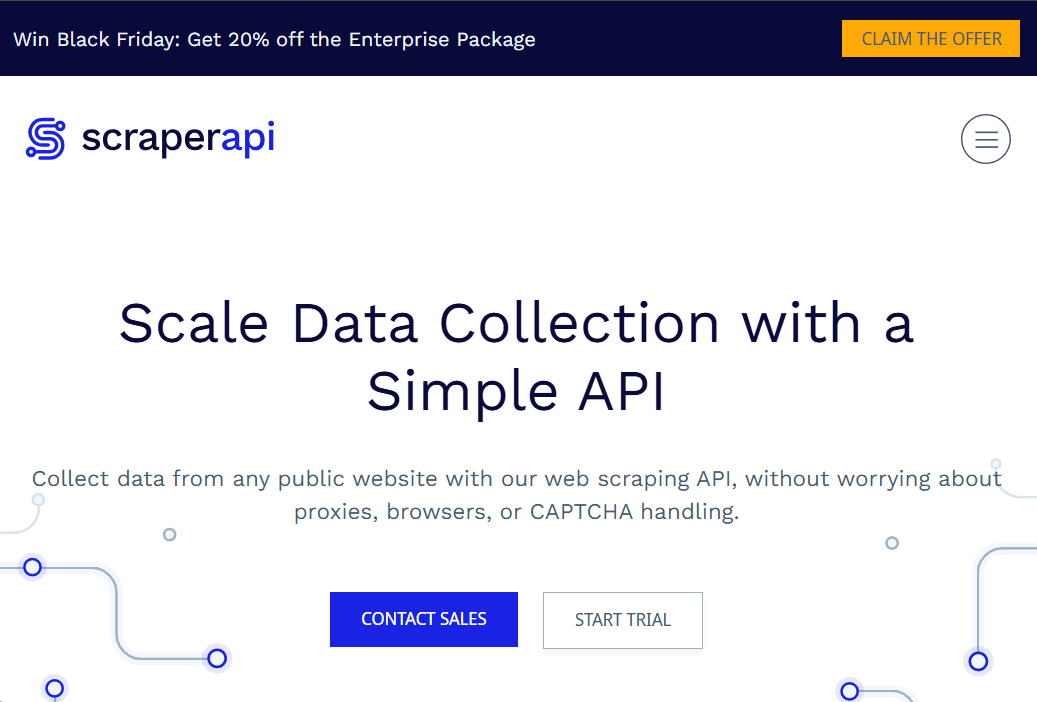
ScraperAPI is a data collection service that handles proxies, CAPTCHA solving, and JavaScript rendering behind a single API call. This makes it perfect for teams that want to scale quickly without managing their own infrastructure.
This data collection company offers:
- Easy-to-use scraping API: letting you send a URL and get back scraped data without managing proxies, browser rendering, or bot blocks
- Async Scraper: automating large-scale web scraping by letting you submit millions of URLs at once, process them in the background, and receive the data when the job is complete
- Automatic bypassing tools: featuring built-in proxy rotation, CAPTCHA solving, and JavaScript rendering that help you scrape complex or dynamic sites without manual configuration
- Structured Data Endpoints: specialized endpoints for popular domains like Amazon, Walmart, and Google Search return clean JSON data instead of raw HTML. If you're scraping Amazon directly without a service layer, our guide on Amazon CAPTCHA bypass covers how to handle the platform's specific anti-bot challenges.
- DataPipeline tools: automating and scheduling recurring scraping tasks through a managed workflow, allowing you to run large data collection jobs, monitor results, and export data in formats like JSON or CSV without building custom infrastructure
All this makes ScraperAPI ideal for e-commerce scraping, price monitoring, SERP data extraction, and other high-volume data collection tasks. With its user-friendly design and focus on simplicity, it makes web scraping easy to scale without managing complex infrastructure.
While it doesn’t offer proxies as a separate product, ScraperAPI does provide access to a large managed proxy network that’s automatically used behind the scenes for every request. It consists of 40M+ IPs in over 50 countries worldwide, which is probably enough for most projects.
With a 4.5-star ranking on TrustPilot based on 42 reviews, and users praising the ease of use and value, ScraperAPI sure deserves a spot on our list of best data collection services for 2026.
Pricing
With ScraperAPI, you only pay for successful requests. It uses a credit-based pricing model where each successful API call consumes credits.
Most standard pages use one credit per call, but more complex tasks like sites that require premium proxies, JavaScript rendering, or CAPTCHA solving use more. Overall, you’re paying for actual, successful data retrieval, and more difficult sites cost more credits as they take more work to scrape.
Plans start at $49 per month, each providing different numbers of API credits, concurrent threads, and locations. There’s also a free trial with 5,000 API credits, so you can test its speed and success rates on your domains before committing.
3. Apify
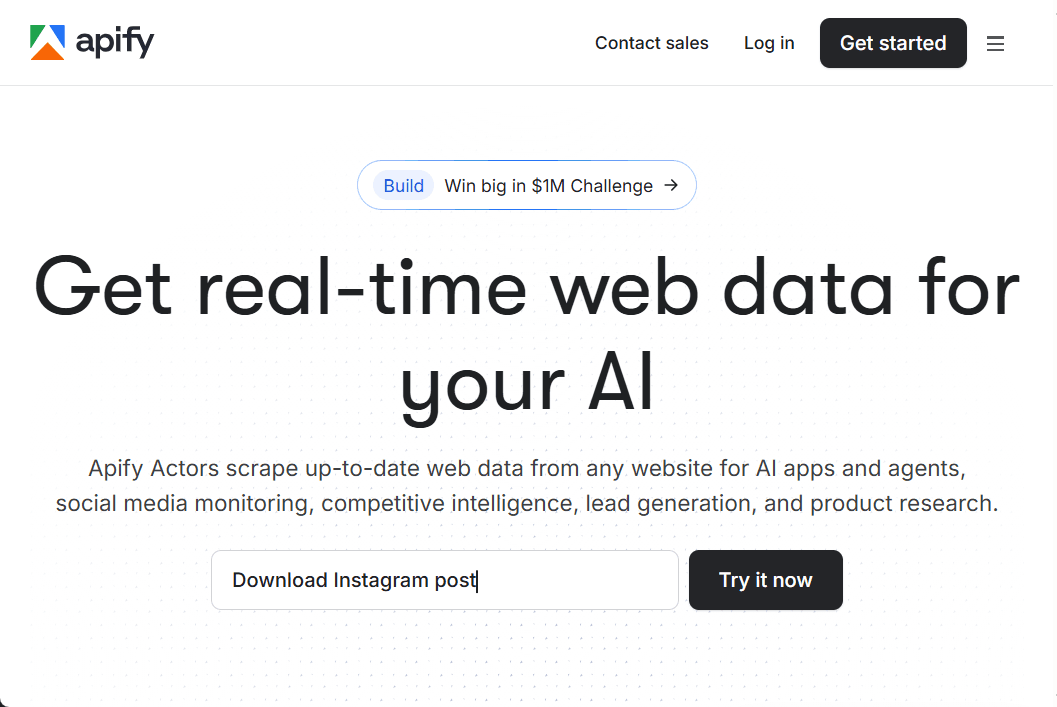
Apify is a full-stack web scraping and automation platform that lets you collect data from any website, automate web workflows, and feed AI applications with structured data. It lets you build, run, and manage web scrapers, called “Actors,” at scale, so it really offers everything you need for efficient data collection.
Some of the provider’s key products and features include:
- Pre-built web scrapers (Actors): thousands of ready-made scrapers for popular sites like Amazon, Google Maps, Instagram, and TikTok
- Custom Actors: allows building your own scrapers or web data automations for your operations or AI tools, with code templates in JavaScript, Python, or TypeScript
- Automatic anti-blocking tools: proxy rotation, CAPTCHA solving, and retry mechanisms that help you scrape protected or dynamic sites reliably
- Scheduling & automation: allows running scraping jobs on a schedule, managing recurring tasks, automating workflows with minimal setup, and exporting results in JSON, CSV, or Excel
- Integrations & API access: allows connecting your Actors to external tools like Google Sheets, Slack, Zapier, or AI pipelines, making data easy to use across apps and systems
Overall, Apify is a great choice for e-commerce scraping, lead generation, market research, social media monitoring, and AI data collection. It allows you to use pre-built scrapers, customize your own, or combine both approaches depending on your needs.
However, the platform is designed with developers in mind, so it might be a bit overwhelming for non-technical users.
But people who do use it seem to love the convenience of its ready-made scrapers, scalability, and responsive customer team. Apify has a high 4.8-star ranking on TrustPilot based on 338 reviews, making it a trustworthy and flexible data collection solution.
Pricing
Similar to ScraperAPI, Apify also uses a credit-based pricing model, but usage here is metered in compute units - the processing power your scraping and automation tasks consume. You get monthly credits to spend on its products, and any excess usage is added to your next invoice, which can be a bit confusing to new users.
The Starter plan costs $39 a month, but the higher the plan, the lower the cost per compute unit. You can add various paid extras such as datacenter proxy, actor RAM, concurrent runs, and personal training for more flexibility.
If you’re not sure which plan is best for your use case, the free plan gives you a $5 credit to test Apify’s features with some limitations.
4. Zyte
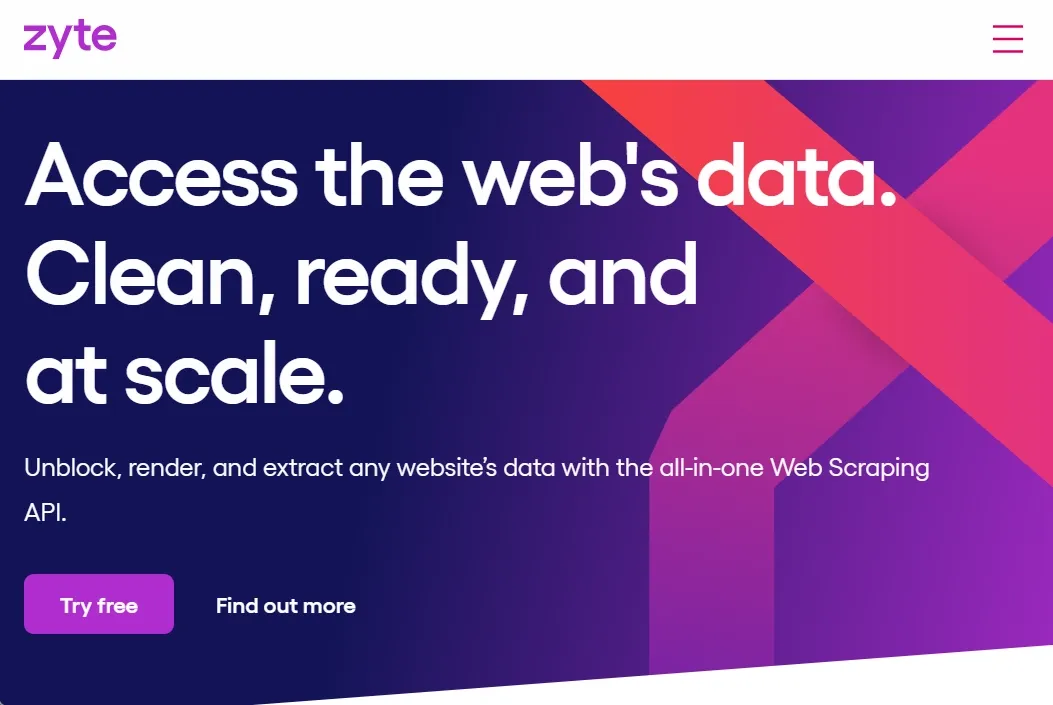
Zyte is another popular service in the data collection industry, especially when it comes to e-commerce data. While it used to provide multiple web scraping products, it’s now focusing on one - Zyte API.
This web scraping API provides:
- Automatic unblocking: managing bans, CAPTCHA challenges, and proxy rotation on your behalf to keep your scraping jobs uninterrupted
- Built-in headless browser: rendering JavaScript-heavy or dynamic pages so you can access all content exactly as a human user would
- AI-powered data extraction: converting pages into structured formats like JSON or CSV, making the data ready for analysis or integration
Unlike SERP APIs or other specialized tools that focus on one category of sites, Zyte API can collect data from any page you want. While it’s powered by machine learning and expert engineers, it also supports a no-code interface.
This makes it great for both technical teams who want full control and less technical-minded users who need to collect and analyze data quickly without coding.
Aside from the unified API, Zyte also offers:
- Web Scraping Copilot: a free Visual Studio Code extension that helps you generate and refine Scrapy spider code using AI‑assisted workflows
- Scrapy Cloud: a cloud hosting and management platform for running, monitoring, and scheduling your Scrapy crawlers
When it comes to user experience and customer support, Zyte leaves much to be desired. It has a 3.7-star rating on TrustPilot based on 15 reviews, with some users saying the platform is complex to navigate. Support response times can also be slower than those of other providers, and tickets are still the main way to contact Zyte’s team.
On the other hand, Zyte offers helpful documentation, a blog, and webinars that cover topics like data maturity, legal compliance, and the use of its API in different scenarios.
Pricing
Zyte’s pricing system can be confusing because the cost depends on multiple factors. However, the Cost Estimator in the dashboard lets you predict the price by entering your target domain, ticking a few feature boxes, and choosing the type of data extraction you need.
In general, Zyte API for Ban Handling charges per successful request, with different prices depending on whether you’re making unrendered HTTP requests or browser‑rendered requests.
Zyte API for AI Scraping charges per 1,000 extracted HTTP responses. There’s a free trial with limited credits to test the API, and enterprise plans are available for high-volume projects with SLA guarantees, higher concurrency, and dedicated support.
5. NetNut
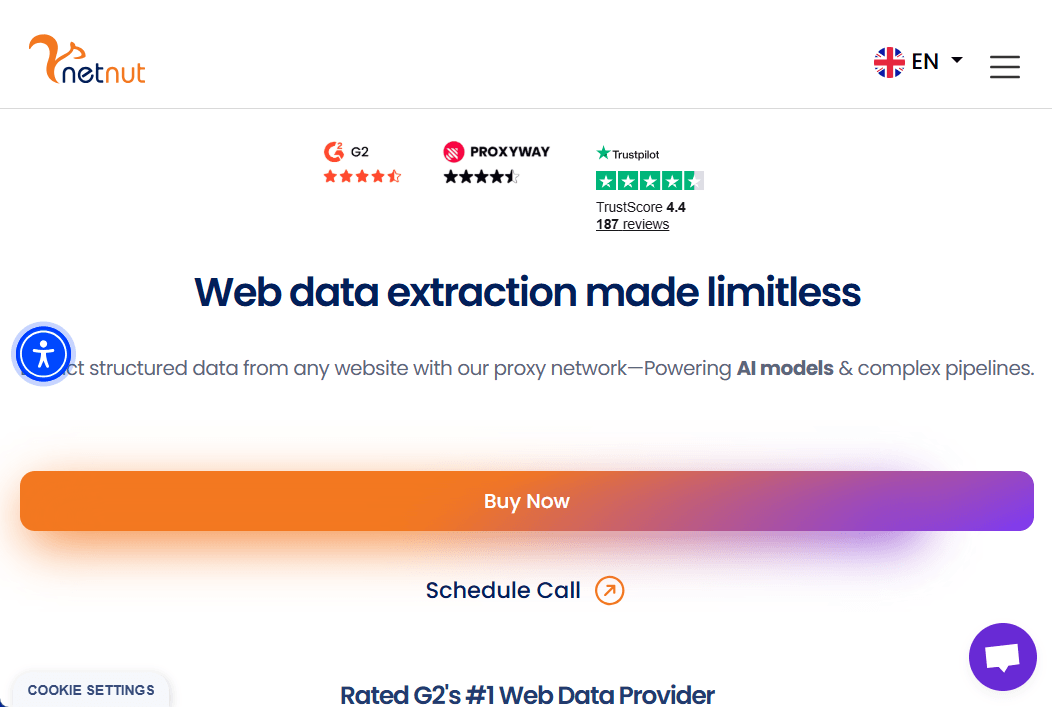
NetNut is a proxy and web data collection provider supporting large-scale web scraping and automated data extraction. It has one of the largest IP networks in the industry and various tools that can help you extract high-quality data for your AI models and pipelines.
Here are the main products of NetNut that can streamline your AI data collection:
- Global proxies: all the main types of proxies in worldwide locations and access to over 85M+ IPs for undetected web data collection
- Scraping APIs: ready-to-use APIs that simplify structured data extraction from websites, such as product catalogs, search results, and other business intelligence data
- Web Unblocker: automatically handles CAPTCHAs, IP bans, and anti-bot measures so your web scraping jobs stay uninterrupted
- Datasets: pre-collected and structured datasets containing over 50 million company profiles and 250 million professional profiles, supporting machine learning and decision-making at scale
NetNut’s web scraping APIs include a B2B Data Scraper API for extracting professional and company data, such as firmographics and LinkedIn profiles. The provider also offers a ChatGPT Scraper API that helps collect and structure AI-generated responses in JSON format. This data can then be used for analytics, SEO research, and AI-driven workflows without requiring manual copy-and-paste.
With all these web scraping tools and a variety of proxy servers, NetNut stands as a solid choice for reliable web data collection at scale, including market research, price monitoring, e-commerce intelligence, and AI model training.
The detailed documentation, FAQs, blog content, proxy integration guides, and webinars with industry experts make it easy to use NetNut’s web data collection solutions and troubleshoot issues. Around 187 reviews on TrustPilot rate the provider with 4.4 stars, although the user experience and live chat response times can be improved.
Pricing
NetNut offers fixed monthly subscriptions for all products, so the plans are not really flexible. All proxy types are billed by bandwidth, while scraper APIs charge per successful request. Pricing starts at $99 per month, which is significantly higher than the starter plans of other providers.
Overall, higher-tier plans offer better value for enterprise-level and high-volume scraping needs. A free plan is only available for proxies, but you have to request it by contacting the sales team. You can pay with a credit card, PayPal, wire transfer, or crypto.
Here’s a side-by-side comparison of the best data collection services in 2026, highlighting their key features, pricing, and best use cases.
Multiple scraping APIs, ready-made & custom datasets, global proxy network, web unlocker
Covers almost any website, reliable proxies, AI-ready datasets, automated unblocking
Subscriptions start at $499/month for APIs & proxies; datasets from $250/100K records; pay-as-you-go available
4.3-star TrustPilot; 24/7 support for higher tiers; dashboard can feel complex
Market intelligence, AI training, price monitoring, SEO research
Scraping API, Async Scraper, automatic bypass tools, structured endpoints, DataPipeline tools
Easy-to-use, scales without managing proxies or infrastructure, structured JSON data
Credit-based pricing; starts at $49/month; pay for successful requests only; free trial 5,000 API credits
4.5-star TrustPilot; praised for ease-of-use; managed proxy network included
E-commerce scraping, SERP data, high-volume data collection
Pre-built & custom Actors, proxy rotation, CAPTCHA solving, scheduling, integrations & API access
Full-stack automation, scalable scraping, customizable workflows
Credit-based (compute units); Starter $39/month; free plan with $5 credit; extras available
4.8-star TrustPilot; developer-friendly; non-technical users may find it overwhelming
Web automation, AI data collection, market research, social media monitoring
Zyte API (automatic unblocking, headless browser, AI data extraction), Web Scraping Copilot, Scrapy Cloud
Scrape any site, supports no-code interface for non-technical users
Ban Handling: per successful request; AI Scraping: per 1,000 HTTP responses; free trial & enterprise plans available
3.7-star TrustPilot; platform can be complex; ticket-based support; documentation & webinars available
E-commerce scraping, custom AI datasets, flexible no-code scraping
Global proxies (85M+ IPs), Scraping APIs (B2B Data & ChatGPT Scraper), Web Unblocker, pre-collected datasets
Reliable large-scale scraping, structured datasets for AI, undetected proxies, market research & AI workflows
Fixed monthly subscriptions; proxies billed by bandwidth, scraping APIs per successful request; starts at $99/month; free trial only for proxies
4.4-star TrustPilot; 24/7 support; live chat ~2h response; documentation, blogs & webinars
Enterprise web scraping, AI training data, e-commerce & market intelligence
How to choose a data collection service
There are many data collection services on the market beyond these five. So, how do you choose the right one for your business? Let’s break down the factors you need to consider before making a decision.
Accuracy and freshness of data
Quality data in web scraping is data that’s accurate and up to date. For example, when searching job postings, outdated listings or missing details can lead to incorrect labor market or salary insights.
Reputable data collection services often have rigorous quality control measures and standards in place to ensure the accuracy and relevance of the data being collected. So when choosing a provider, look for services that refresh data frequently, offer reliable scraper APIs, support browser rendering for dynamic content, and rely on strong proxy networks with precise geo-targeting options.
This way, you can rest assured that the information you collect is accurate, fresh, and ready to be turned into actionable data insights.
Scalability and speed
Your data collection service should be able to scale with you as your needs grow. Whether you’re scraping a few hundred pages or millions of URLs per day, you need speed and reliability for timely insights.
Look for providers that offer flexible plans, high concurrency, and large proxy pools so you can adjust your usage as needed without overpaying or hitting limits.
Features like asynchronous scraping, cloud-hosted infrastructure, and support for massive datasets ensure fast, reliable collection of job postings, images, pricing data, or any other information at scale. This way, your AI data collection and analytics pipelines can expand seamlessly as your business grows.
Compliance and data ethics
Collecting data responsibly is just as important as collecting it accurately. So, choose a data collection service that follows legal guidelines, adheres to privacy regulations like GDPR and CCPA, and supports responsible and compliant data collection practices.
Services that support ethical scraping can help you avoid legal risks while maintaining high-quality, trustworthy datasets.
Integration capabilities
A good data collection service should easily integrate into your existing workflow. That means it should offer clear API documentation, pre-built integrations with CRMs or analytics platforms, and no-code tools or low-code interfaces for easy setup.
Make sure the service offers AI web scrapers, built-in proxies, and support for the data type you need, whether text, images, video, or audio. This way, you can streamline web scraping and AI data collection without wasting time, budget, or effort.
Industry use cases
While most data collection services cater to different industries and use case needs, some align better with specific business goals. For example, you can find data collection services that are better suited for eCommerce data, like pricing, reviews, and product images, and others that specialize in finance, healthcare, or B2B intelligence.
Gaining insights into customer behavior, feedback, and preferences enhances customer understanding. This deeper understanding leads to an improved customer experience, increased satisfaction, and stronger customer loyalty.
Therefore, choose a provider with proven experience in your industry to ensure higher success rates and more relevant data outputs.
Industry-specific data collection recommendations
Choosing a data collection provider tailored to your specific needs ensures faster results, higher-quality data, and more effective AI data collection. Here are a few recommendations for some of the most popular use cases and industries.
Best for market research
The right service will help you access real-time consumer trends and insights, which are crucial for market research. Choose a service that provides diverse data collection methods and access to high-quality structured datasets.
This service should support AI data collection for trend analysis, competitor insights, and customer sentiment, including reviews and product listings.
Best for price monitoring
Price monitoring requires real-time, accurate data from multiple sources, including e-commerce platforms and marketplaces. That’s why data collection services with robust scraper APIs, global proxy networks, and automated web unblockers are perfect for this job.
Utilizing data analytics to monitor market trends and competitor performance helps you gain a competitive advantage and respond faster to market changes. These services help ensure your AI data collection captures real-time pricing, promotions, and availability, so you can detect trends and optimize pricing strategies. If your monitoring extends to tech hardware drops, our AMD proxies are purpose-built for securing limited releases on AMD's store.
If you'd rather use a dedicated tool instead of a full data collection service, see our roundup of the best proxies for retail price tracking Walmart target for lighter, purpose-built options.
Best for AI/ML training data
High-quality datasets are crucial for training AI systems and supporting informed, data-driven business decisions. Services specializing in AI data collection provide ready-made or custom datasets, including text, images scraper, or multimedia.
This way, they help your models train on accurate, up-to-date information for better performance and reliability.
Best for lead generation
For lead generation, it’s important to use a service that can reliably extract professional and business data at scale. AI web scrapers, proxy support, and automated anti-blocking tools ensure access to contact details, company profiles, and other structured data, which can then feed sales or AI-driven marketing tools.
Conclusion
Data collection services offer scalable, cost-efficient, and AI-enhanced alternatives to outdated copy-paste methods. No wonder companies using automated data collection tools report 30-40% time savings and up to 20-30% cost savings, making them essential rather than optional.
The only question left is which service is best for your business needs. Many data collection services offer free trials to help users evaluate their offerings. So take advantage of them to test features like scraper APIs, proxy networks, web unblockers, and datasets, and use our quick reviews to make the right decision.
What’s the difference between web scraping and data collection?
Data collection is gathering information from any source, using any method, for analysis or use. It can include data from APIs, databases, surveys, sensors, files, and websites, and it often involves dashboards, charts, or images that visualize or summarize the collected data.
Web scraping is a specific data collection method that focuses only on websites. It uses automated tools or scripts to extract data directly from web pages, which may include text, tables, metadata, and even image URLs or image data embedded in the page.
Web crawling is another term often confused with web scraping, but it focuses on discovering and indexing web pages rather than extracting specific data from them.
How much do data collection services cost?
Costs vary depending on the provider, the volume of data you need, the target sites, and the specific tools you use. Some services offer pay‑as‑you‑go pricing, charging per successful request (e.g., per 1,000 responses), while others use monthly subscription plans with bundled usage.
What is the best data collection tool?
There isn’t a single best tool for everyone. The right choice depends on your goals, budget, technical needs, and the type of data you want to collect. So explore more providers to see what each of them offers and take advantage of free trials before making your decision.
How is AI used in data collection?
AI makes the data collection process faster, smarter, and more accurate. It can automate scraping and extraction, filter and clean data, enhance data analysis, and support AI-driven workflows by feeding data into machine learning systems for tasks like predictive analytics, natural language processing, or image recognition.
How do AI companies collect data?
AI companies collect data from public websites, APIs, licensed datasets, user interactions, and internal systems. They use automated tools to extract, clean, and organize this data, which is then used to support analytics, machine-learning systems, and AI-powered applications.