Key takeaways:
- A VPS provides a remote computing environment for hosting websites, applications, and other services.
- A proxy routes your internet traffic through another server, so the website sees the proxy’s IP address instead of yours.
- Proxies are best for tasks like web scraping, accessing geo-specific content, and managing multiple IP addresses.
- Residential proxies are particularly useful when you need IP addresses associated with real residential internet connections.
- You can use a VPS and proxy together when you need both server infrastructure and flexible IP routing.
If you’re choosing between a VPS and a proxy, the main question is what you actually need: a server to run websites, software, and applications, or a way to route your internet traffic through a different IP address? A VPS provides the former, while a proxy provides the latter.
The two overlap in one respect: both involve traffic passing through a remote server, and both can affect which IP address a website sees. With a VPS, only if you deliberately configure it to route your traffic, though. Beyond that, they work differently and serve different purposes.
In this article, we’ll compare VPS and proxy servers, explain their main differences and use cases, and help you choose the right option for your case.
What is a virtual private server?
A virtual private server (VPS) is a virtual machine running on a physical server in a data center. Virtualization creates isolated environments within the physical machine, each having its own OS with allocated CPU, RAM, storage, and network resources.
For example, if you want to host a website, you can rent a VPS, install the necessary web server software, and connect your domain. The VPS then provides the computing resources and environment needed to keep the website online.
Unlike traditional shared web hosting, a VPS gives you more control over the server environment, allowing you to install and configure the software your project requires.
What is a proxy server?
A proxy server routes your internet traffic through a separate server before it reaches its destination, such as a website. Because the initial request goes through the proxy first, the website sees the proxy’s IP address instead of your original one. Depending on the proxy type, you can also choose an IP associated with a specific location.
Residential proxies are particularly useful when you need IP addresses associated with real residential internet connections. It’s especially the case when it comes to web scraping, market research, or accessing geo-specific content.
How are VPS and proxy servers different?
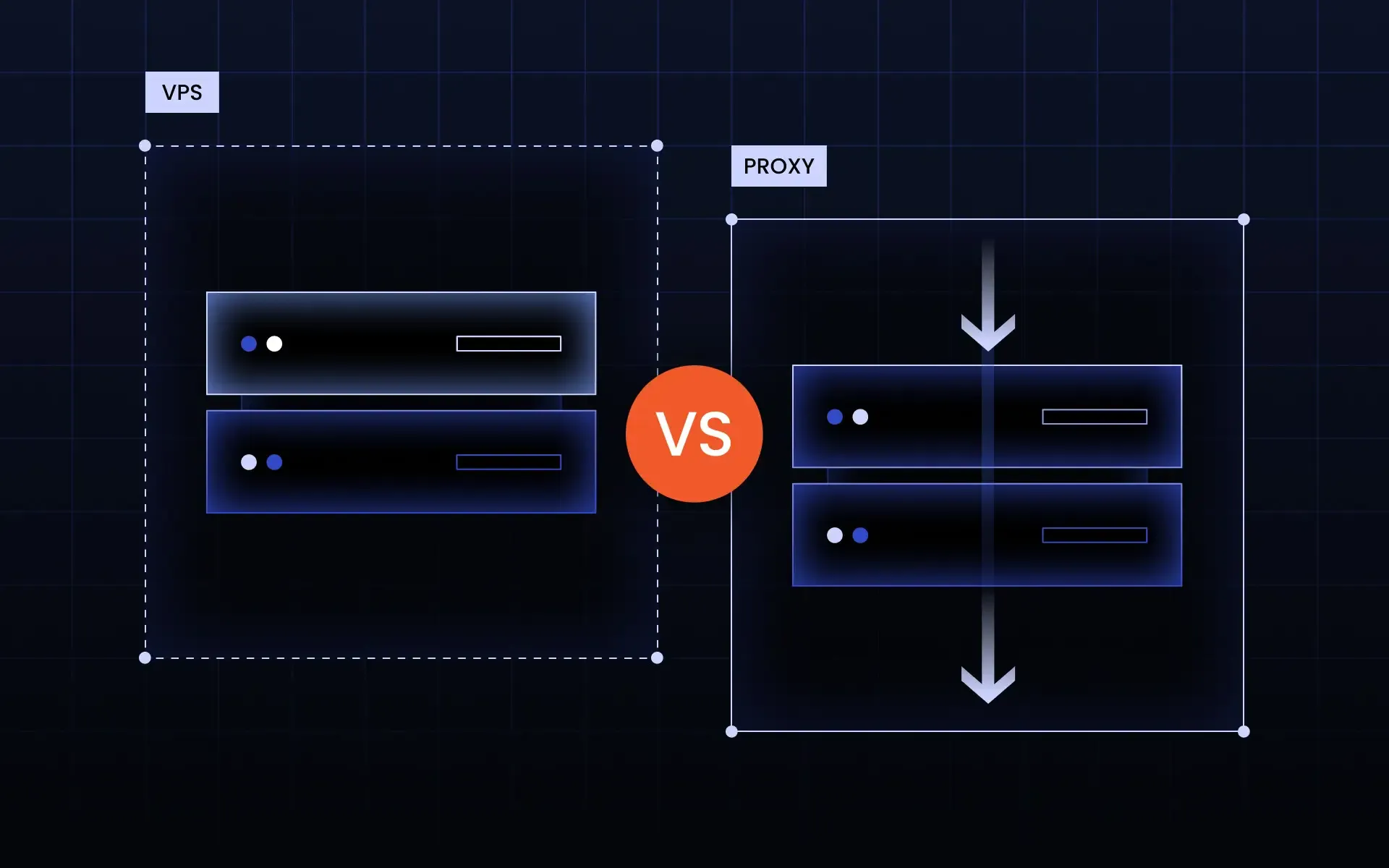
The key difference between a VPS and a proxy is how they work and what they are used for. A VPS gives you your own virtual environment for running websites, apps, and services. A proxy, on the other hand, sits between your device and the internet and forwards your request through a different IP address.
Simply put, a VPS is where you run things, while a proxy is what you route your traffic through.
For example, if you’re building a website, you need a VPS or another web hosting solution to run it. If you’re scraping data from websites and need requests to come from a different location, a proxy server would be more relevant, especially residential proxies, since they can provide IP addresses in the specific countries and cities you need for data collection.
VPS and proxies aren’t mutually exclusive – you can run proxy software on a VPS as the server supporting your proxy setup. This gives you more control over the configuration, but it won't give you the IP pool a proxy service provides. MarsProxies, for instance, offers over 1 million residential IPs across 190+ locations.
VPS vs proxy: common use cases
As we’ve seen, VPS and proxies serve different functions – hence, they tend to be useful in different scenarios.
When to use a VPS
A VPS is the first choice when you need a remote environment to run and manage your own software or services, for example:
- Web hosting for sites and applications
- Hosting game or email servers
- Running databases and backend services
- Developing and testing applications
- Storing and managing files
For example, a company can use VPS hosting to run its website without maintaining a physical server. Developers can also use a VPS to deploy applications or create an environment for testing.
When to use a proxy
A proxy would be a more relevant choice when you want to control how your internet traffic reaches websites and which IP address they see. Common use cases:
- Web scraping and collecting publicly available data
- Accessing geo-specific content
- Ad verification
- Managing multiple online accounts
- Browsing through a different IP address
- Distributing requests across multiple IP addresses to reduce rate limiting
For location-sensitive tasks, residential proxies are particularly useful because they grant IP addresses associated with actual residential internet connections.
VPS vs proxy: which should you choose?
A VPS and a proxy aren’t the same thing or interchangeable in any way – the right solution depends on what tasks you need to accomplish.
Choose a VPS if you need a server environment for hosting websites, running applications, or managing your own software. A VPS gives you the resources and access required to configure and operate these services.
Choose a proxy if you need to route traffic through different IP addresses, target specific locations, or support web scraping tasks. Residential proxies are usually the best fit when you need an IP associated with a real residential connection.
You can also use VPS and residential proxies together if your project needs both server infrastructure and flexible IP routing.
Purpose
Runs software and hosts services
Routes traffic through a different IP address
Control
Root access to the operating system
No operating system access; configuration set by the vendor
IP addresses
One or a few static IPs
Access to large IP pools across many locations
Resources
Dedicated CPU, RAM, and storage
Shared infrastructure; no compute allocated to you
Hosting
Can host websites, apps, and databases
Cannot host websites
IP rotation
Not available by default
Built in, per request or per session
Use cases
Hosting, databases, backend services, automation
Data collection, geo-specific content, ad verification, multi-account management
FAQs
Is a VPS the same as a proxy?
No. A VPS is a virtual server that provides computing resources and an operating system, while a proxy is an intermediary that forwards internet traffic through another IP address.
Can a VPS be used as a proxy?
Yes. A VPS can be turned into a proxy by installing and configuring proxy software on it. This gives you a proxy with the VPS’s IP address – however, it won’t provide the large IP pools, location selection, or residential IPs.
Can you use a proxy for web hosting?
No. A proxy doesn’t provide the server environment needed to host a website or application. You need a VPS, dedicated server, or another web hosting solution for that purpose.
Is a VPS better than a proxy for web scraping?
Not necessarily. A VPS server can provide the infrastructure to run your scraper, but a proxy is what routes its requests through a different IP address. For large-scale or geo-specific web scraping, it’s best to use residential proxies.
Are residential proxies better than a VPS?
They serve different purposes. Residential proxies are designed for routing traffic via residential IP addresses, while a VPS provides a virtual computing environment for running software and services.