Key takeaways:
- You can start a proxy business through an affiliate program, a proxy reseller partnership, or by building your own infrastructure.
- Affiliate programs have the lowest startup costs and are best suited to creators, developers, and marketers.
- Reselling proxies requires more setup but gives you more control over your brand.
- Building your own proxy infrastructure offers the highest level of control, but it is also the most expensive to set up.
Starting your own proxy business in 2026 is an excellent idea if you understand what is driving demand. Automated traffic grew 23.5% year over year in 2025, about eight times faster than human traffic, according to HUMAN Security’s State of AI Traffic report.
That growth helps explain the demand for proxy services, because automated tools need reliable proxy infrastructure. It also explains why IP quality can make or break your own proxy business. Imperva reported that automated traffic reached 53% of web traffic in 2025, while bad bot activity rose to 40%, so websites have more reason to scrutinize request sources, session behavior, and traffic patterns.
This guide shows you how to start your own proxy business with a clear plan. You will compare reseller, affiliate, and self-hosted models, then see how proxy infrastructure, wholesale rates, and customer demand shape the business.
What is a proxy business?
A proxy business sells proxy resources to people or companies that need them. If you are new to proxies, a proxy is a simple tool that reroutes traffic through alternate IP addresses, depending on the type and configuration.
Proxies have many uses today, including:
- Web scraping
- Privacy
- Bypassing geoblocks
- Load balancing
- Managing multiple social media accounts
- Ad verification
- Market research
- Automation workflows that need stable IP rotation
And as mentioned above, the demand is there. But to start a proxy business in 2026, you need to know the upfront cost, which depends on the business model you choose. That model directly affects the profit you can make. More on that below.
Three ways to start your own proxy business
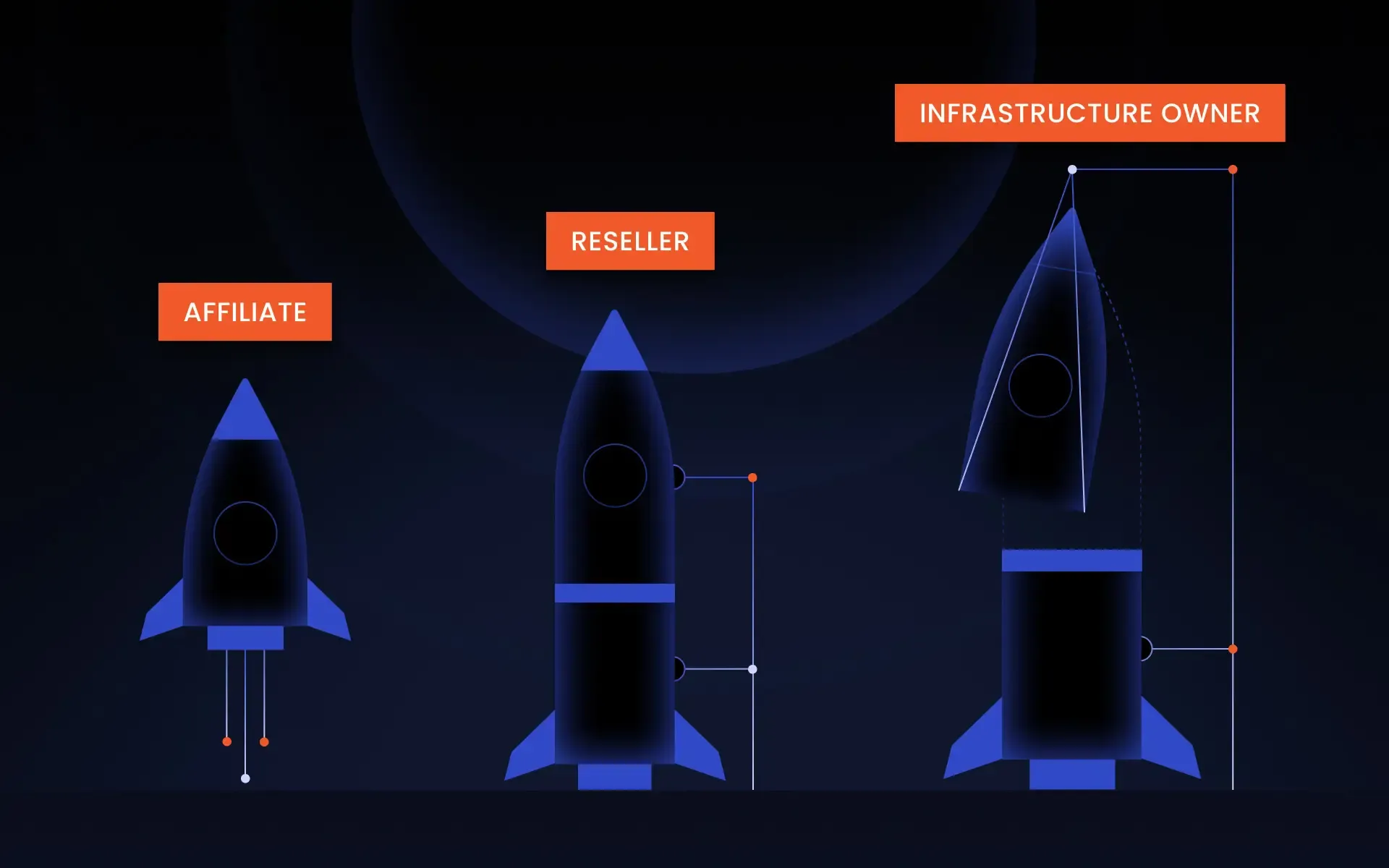
There are three ways to start a proxy business in 2026:
- Join an affiliate program
- Join a proxy reseller program
- Build your own proxy infrastructure
As you move from affiliate marketing to reselling and then to building your own proxy infrastructure, the upfront cost usually increases. The potential return can increase, too, but so does the work involved.
Let’s talk about each method in detail.
Join a proxy affiliate program
The first way you can start a proxy business in 2026 is to join an affiliate program, like the MarsProxies affiliate program. This is the easiest starting point if you are a YouTube creator, GitHub developer, SEO writer, tech writer, or someone with an audience that already cares about proxy services.
In this model, you don’t have to run a proxy server, manage residential proxies, or handle customer support - the proxy provider takes care of that. You promote the service and earn a percentage of the sales generated through your link.
The MarsProxies affiliate program, for instance, offers a 40% commission on every qualifying sale, up to $1,000 per transaction. That means every time someone buys through your affiliate link, you earn 40% of what they spend. So if someone spends $100 through your link, you earn $40. If your cost of acquiring that customer was less than $40, you made a profit.
So the upfront cost for this model depends on whether you already have an audience or need to build one first, and how much it costs to reach the right buyers.
Alternatively, you could join a proxy referral program, where you recommend a proxy service to your friends and colleagues and earn a commission when they purchase through your unique link. This model requires little to no upfront investment, but its earning potential is lower than that of an affiliate program.
For example, the MarsProxies refer-a-friend program pays you a 10% commission every time someone orders proxies through your link. You can withdraw your earnings once they reach $30, making it a quick and easy way to start a proxy business in 2026.
Join a proxy reseller program
The second option is a proxy reseller program. This requires more setup than an affiliate program and usually has a higher upfront cost. But if you get it right, the profit potential is much greater.
Here’s how it works: you buy proxy access or bandwidth in bulk from a proxy provider, then sell it to your own customers through your own business. You will likely need to create a website, set your pricing, handle support, and build the offer around your own brand.
For example, MarsProxies residential proxies become cheaper when you buy more traffic. 1 GB costs $4.99, but 10,000 GB costs $1.65 per GB, so your total cost for 10,000 GB would be $16,500. From there, you can use the MarsProxies Residential Proxy API to connect that residential proxy traffic to your own reseller setup. The API lets you:
- Create and manage sub-users
- Check available traffic
- Add traffic to users
- Retrieve user statistics
If you resold that same traffic to your customers at $3.50 per GB, your revenue would be $35,000. That leaves a gross margin of $18,500 before website costs, payment fees, support, refunds, and marketing.
That’s why a proxy reselling business can be profitable. You are buying at wholesale rates and selling under your own brand. The margin, though, only works if your setup costs are lower than the spread between what you pay and what your customers pay you.
Build your own proxy infrastructure
The last option is building your own proxy infrastructure. This is the most expensive approach and takes the most work to set up because you’re not just selling proxy access. You’re building the system behind the proxy service.
With this model, you’ll need to run datacenter proxy infrastructure, source residential IPs through compliant networks, manage uptime, protect IP reputation, and market the service to your audience. Building your own proxy infrastructure can cost $100,000 or more, which is why this model is usually better suited for funded teams with technical, legal, and compliance support.
Affiliate vs. reseller vs. own proxy infrastructure
Startup cost
Low
Moderate to high
Very high, potentially $100,000+
Technical knowledge
Low
Moderate
Advanced
Time to launch
Days to weeks
Weeks to months
Months to years
Profit margins
Limited to commission rates
Higher margins between wholesale and retail prices
Highest potential, but with major operating costs
Scalability
Easy to scale through audience growth
Highly scalable with a reliable provider
Highly scalable, but capital-intensive
Best suited for
Creators, developers, and marketers with an audience
Businesses that want to sell proxies under their own brand
Funded teams with technical, legal, and compliance expertise
How to launch your proxy business: step by step
Now that you know what a proxy business is and the different models you can use to start one, let’s talk about how to launch your own proxy business step by step.
Step 1: Identify your target audience
Demand for proxy services keeps growing, but you still need to find the specific segment you can profit from. Your target audience will affect the proxy types you offer and the business model you choose.
For example:
- If you have a YouTube channel that teaches web scraping, your audience may need web scraping proxies they can use with the tools you already explain.
- If you sell an SEO ranking tool, your customers may need proxies for location tracking. In that case, you could resell SEO proxy access inside the tool instead of making users buy it separately.
- With enough funding, technical infrastructure, compliance support, and time, you can build a company to compete with other proxy providers for general proxy users.
Step 2: Choose your business model
The audience you choose will directly affect the model you go with. An affiliate model fits if you already have attention. A proxy reseller program is a good fit if you want to sell proxy services under your own brand. Building your own proxy infrastructure would be a better option if you can handle the cost and technical work.
Step 3: Find a reliable proxy provider or partner
Depending on the model you choose, the next step is to find an established proxy provider with a comprehensive portfolio of robust IPs and transparent, ethical sourcing to work with. For options, see our list of the best proxy providers of 2026.
Step 4: Set pricing and goals
With your audience, model, and provider set, calculate your upfront costs and factor in proxy access, website setup, support, marketing, and payment fees. Then set a price that leaves enough room for profit. Remember to set measurable goals so that you can track your business growth.
Step 5: Build your website and brand
The need for a new brand or website depends on your model. Affiliates may already have a brand, and resellers may sell proxy access inside an existing tool. But if you are building your own proxy infrastructure, then creating your brand and your website can become a major cost.
Step 6: Market your proxy services
Now it's time to market your proxy services. Your model and audience will determine how much work this takes. If you already have an audience, focus on making them aware of the offer. If you do not, you will need to build that audience first through niche targeting and content marketing, which can increase your budget.
Step 7: Monitor, support, and retain customers
Once your model is working, pay attention to the parts that affect customer retention. Monitor proxy reliability, customer feedback, support requests, and usage patterns. Then adjust your proxy services as needed so customers have a reason to keep buying from you, which supports your business growth.
Common mistakes when starting a proxy business
Mistakes happen when starting any business, but the fewer you make, the better your chances are. If you want to start a proxy business in 2026, these are the mistakes you should avoid.
- Choosing the wrong model
An affiliate model will be hard to run if you do not already have an audience. A proxy reseller program will be challenging if you do not have a clear reason for customers to buy from you rather than going straight to the proxy provider. Choose the business model that fits your audience.
- Competing only on price
Proxy prices have been going down for the last few years, so competing only on price will pull your margins down. Instead, build the offer around a specific use case.
- Selling without customer support
Proxies are technical products, and issues will come up while customers are using them. If you are running a proxy reseller program or building your own proxy infrastructure, you need support ready to respond to these issues.
- Using unreliable proxy providers
If you partner with a company for proxy access, make sure the provider is reliable. Their IP quality, uptime, and support will affect your customers directly. If the proxies fail, your customers will see it as your problem, not the provider’s.
All the best as you start your proxy business in 2026!
FAQ
What is a white-label proxy?
A white-label proxy is a proxy service you sell under your own brand, while another provider supplies the proxy infrastructure. You can offer residential proxies, datacenter proxies, or other proxy types without building the network yourself. That's why choosing a reliable proxy service provider matters most in this model.
How long does it take to build a successful proxy business?
The time it takes to build a successful proxy business depends on your model, the audience you target, and your budget. If you already have an audience interested in proxies, you can launch quickly and scale using the affiliate or reseller models. Building your own proxy infrastructure can take years, even with funding.
Can I start a proxy business without owning proxy infrastructure?
Yes. You can start a proxy business without owning any proxy infrastructure by partnering with an established provider. The affiliate model allows you to promote its services and earn commission on purchases made through your link, or you can buy proxy traffic at wholesale rates and resell it under your own brand.
What type of proxies should I sell or promote?
You should sell or promote the proxy types that are relevant to your target audience. For instance, web scraping users may need residential proxies for better IP quality, while gamers and devs may need SOCKS5 proxies for stable data transfer. The right choice depends on the use case you want to serve.
Is proxy business legal?
A proxy business is legal when it follows applicable laws, privacy rules, and acceptable use standards. The biggest risk is in how you source your IP addresses and how your customers use them. That’s why it is important to work with ethical partners and use clear terms of service.